Drafted 06/01/2026
Published 06/06/2026
Download our May 2026 Market & Economic Framework as a PDF HERE
OVERVIEW
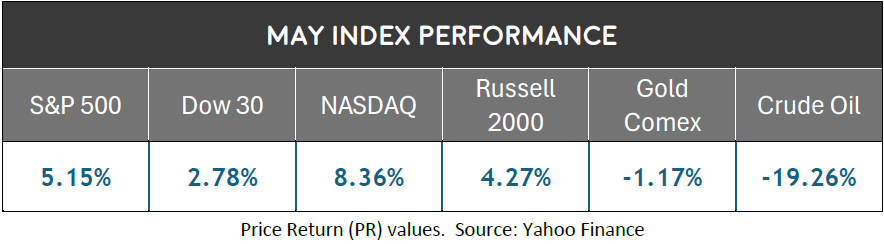
After a volatile start to the year, equities continued their rebound in May. While markets did lose some momentum from the massive April rally, the month saw strong gains against minimal volatility. Investors looked past rebounding inflation and rallied alongside falling oil and “safety” assets (such as gold).
The month of May continued April’s trend of rallying on strong corporate earnings. The most recent “earnings season”, which began in April, saw a massive revision upward in both current and expected future corporate earnings. While stocks rallied during this period, they moved up somewhat proportionally to the positive earnings news. Stocks are modestly more expensive on a price-to-earnings basis than they were during the March lows.
While inflation remains a persistent (and increasing) headwind, the broader set of economic and market indicators which we track continues to reflect a generally stable and supportive environment.
LIFETIME MOMENTUM & VOLATILITY INDEX
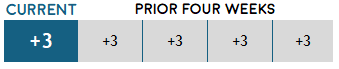
Lifetime Retirement Partners maintains an index designed to measure short-term stock market momentum and volatility. The Lifetime Momentum & Volatility Index (LMVI) provides guidance on when to adopt a more conservative or aggressive posture within portfolios. The idea is not to “time the market”, but to identify periods of elevated risk or improving conditions.
The LMVI turned negative (risk-off) in February. However, since April 3rd it has returned a consistently positive value. The current reading of +3 (on a scale of -4 to +4) reflects that volatility has declined and momentum has returned to the stock market. This encourages a fuller expression of risk within portfolios.
Download the most recent LMVI Report HERE (revised 2026-06-01)
LIFETIME EARLY WARNING SYSTEM (LEWS)
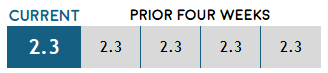
Lifetime Retirement Partners maintains an index which measures economic fragility. The Early Warning System is not intended to be a recession predictor, per se, but is calibrated to score eight market and economic indicators which tend to be leading indicators of weakness.
While the score ticked up slightly at the onset of the Iran conflict (and subsequent market sell-off), it finished May where it has sat for most of 2026: a “benign” score of 2.3 (out of 10). This indicates very little fragility in the economy. This isn’t predictive that investments will go up, but it does indicate a clear economic runway with a lack of fundamental stress.
Download the most recent LEWS Report HERE (revised 2026-06-01)
MACROECONOMIC INDICATORS
Our proprietary economic database evaluates Macroeconomic Indicators across two separate categories: Real Consumer Demand and Economic Growth and Activity. The score remains positive, where it has resided for over a year, reflecting a stable economic backdrop.
REAL CONSUMER DEMAND: Inflation remains a key pressure point for both the economy and the consumer. The latest Personal Consumption Expenditures (PCE) inflation reading is higher than a year ago and pricing pressures have reasserted themselves.
ECONOMIC GROWTH & ACTIVITY: While GDP data has been weak in the prior two quarters, partly influenced by tariffs and a government shutdown, tools such as the Federal Reserve Bank of Atlanta’s GDPNow calculator forecast strong growth in coming quarters. Additionally, broader measures such as Gross Output, along with continued expansion across services and manufacturing sectors, suggest that underlying economic activity remains intact. Additional production indicators, including truck tonnage shipped, have improved year-over-year, reinforcing the view of continued expansion.
LEARN MORE: OUR MACROECONOMIC INDICATORS SLIDE DECK (revised 2026-06-01)
MONETARY INDICATORS
Our proprietary economic database evaluates Monetary Indicators across two separate categories: Federal Policy & Lending & Liquidity. The score remains positive, where it has resided for over a year, reflecting a broadly supportive monetary backdrop.
FEDERAL POLICY: While odds of further Federal Reserve rate cuts have declined dramatically from the beginning of the year, they are still 25% lower than the 2024 peak. Money supply (M2) has expanded at a moderate pace over the past year, well below the surge seen during the pandemic and consistent with a stable growth environment.
LENDING & LIQUIDITY: Bank lending has steadily increased over the past year, supporting economic activity. While business loan delinquencies have moved slightly higher, they remain contained and do not currently signal meaningful stress in credit conditions.
LEARN MORE: OUR MONETARY INDICATORS SLIDE DECK (revised 2026-06-01)
CONSUMER STRENGTH INDICATORS
Our proprietary economic database evaluates consumer strength across two primary areas: Employment and Consumer Health. The current overall score is +1 (neutral), reflecting a stabilization from earlier weakness (the score was negative to start the year).
EMPLOYMENT: The improvement in our overall grade relates to stabilizing employment conditions, which have improved modestly. Initial jobless claims remain low, and after a gradual rise through 2025, most key unemployment measures have shown improvement. The labor market continues to reflect a “low hire, low fire” environment which has strengthened in the first part of the year.
CONSUMER HEALTH: While concerns around a stretched consumer persist, the data remains more balanced than media narratives suggest. Household debt has increased year-over-year but at a moderate historical pace. Consumer delinquency rates have edged higher from recent lows but remain near longer-term averages. At the same time, real wages have outpaced inflation for twelve consecutive quarters, providing continued support for consumption.
LEARN MORE: OUR CONSUMER STRENGTH SLIDE DECK (revised 2026-06-01)
MARKET FUNDAMENTALS
While our framework does not assign a formal score to stock market fundamentals, the current assessment remains positive, reflecting a broadly supportive backdrop for equities.
Because of the massive recent run in equities, we have downgraded our outlook from “Positive” to “Moderately Positive” in the near future. The forward price-to-earnings ratio of the stock market, which ended May at 22.37 is modestly higher than where April finished (21.79). It is roughly at parity with where the year started (22.27). While the recent stock rally is technically justified, it will be difficult for stocks to maintain their recent rally until the next earnings season begins in July. Until then, we are likely in a window of increased volatility and markets which will be more sensitive to price pressures (oil, inflation) and headline news (Iran) than they were in May.
LEARN MORE: OUR MARKET FUNDAMENTALS SLIDE DECK (revised 2026-06-01)
CONCLUSION
While the April-to-May rebound was rapid, it was not without foundation. Improving momentum, stabilizing economic conditions, and broadly supportive earnings results have combined to create a constructive backdrop for equities. At the same time, key risks remain. These include persistent inflation pressures and the potential for renewed volatility following such a sharp recovery, along with the possibility of another “flare up” in the Iran conflict. As a result, the current environment supports participation in the market, but with an awareness that conditions can shift quickly.
Contact us or ask questions! tony@lifetimeretirementpartners.com