Your savings, organized by when you’ll need them.

Turn retirement savings into a written income plan. NextPhase gives each portion of your money a purpose, based on when you expect to need it.

Six galvanized buckets on farmhouse porch steps at golden hour: the nearest hold still water, the farthest hold tall green plants

The Challenge

How much can I safely spend?

Compare your expected expenses with income sources and planned withdrawals.

How much investment risk can I handle?

Consider both your comfort with market changes and your need for dependable income.

Are my retirement savings in the right place?

Separate near-term spending needs from longer-term growth goals.

Do I have enough retirement savings to last my lifetime?

Explore how longevity, inflation, and changing expenses could affect your plan.

NextPhase starts by giving each part of your savings a purpose—and a time horizon.

Why retirement timing matters.

Watch the 2-minute explanation of timing risk, then explore how the NextPhase buckets work.

Video length: 2:12. Historical illustrations are not predictions of future results. Investing involves risk, including possible loss of principal.

Plan for the risks that matter.

Retirement changes the job your savings need to do. Your plan needs to address withdrawals, rising costs and the possibility of a long life—together.

Timing risk

Timing risk, also called sequence-of-returns risk, is the risk that poor investment returns arrive while you are drawing income. Selling investments after a decline leaves fewer assets available for a recovery. That can shorten how long savings last, even if long-term average returns appear reasonable.

How we help: separate spending from growth

NextPhase assigns near-term withdrawals to segments that emphasize stability, allowing later segments more time to pursue growth. We review spending needs, existing income and available reserves together, and revisit withdrawals or segment timing when circumstances change.

A reserve can be depleted, and markets may not recover before later assets are needed. Segmentation does not prevent losses or guarantee income.

Inflation risk

Inflation risk is the loss of purchasing power as prices rise. The same monthly income may buy less food, healthcare, housing and travel over time. Even modest increases can compound over a long retirement, and your household’s costs may rise differently from a broad inflation measure.

How we help: plan for future spending

We include rising expenses in the income plan and distinguish income that may adjust over time from payments that stay fixed. Later NextPhase segments seek growth to help support future purchasing power. Reviews compare your actual costs and investment results with the assumptions behind the plan.

Growth investments can lose value and may not keep pace with inflation. Future income targets are planning goals, not guaranteed increases.

Longevity risk

Longevity risk is the possibility of outliving the resources set aside for retirement. A longer life can mean more years of withdrawals, rising costs and changing care needs. For couples, the plan also needs to consider how income and expenses could change when one spouse outlives the other.

How we help: look beyond the early years

We review your planning horizon, essential expenses, Social Security, pensions and savings together. NextPhase includes a segment for year 26 onward or legacy goals. Where appropriate, the discussion can also include an optional lifetime-income strategy and the trade-offs between income, liquidity and leaving assets to others.

No investment withdrawal plan guarantees that savings will last for life. Annuities have costs and restrictions; any insurance guarantee depends on contract terms and the issuing insurer’s claims-paying ability.

One coordinated income plan.
Review the buckets alongside existing income, an accessible cash reserve and your changing needs.

These are planning responses, not guarantees. Investments may lose value. Any insurance guarantee depends on the issuing insurer’s claims-paying ability and the terms of the contract.

A purpose for each part of your savings.

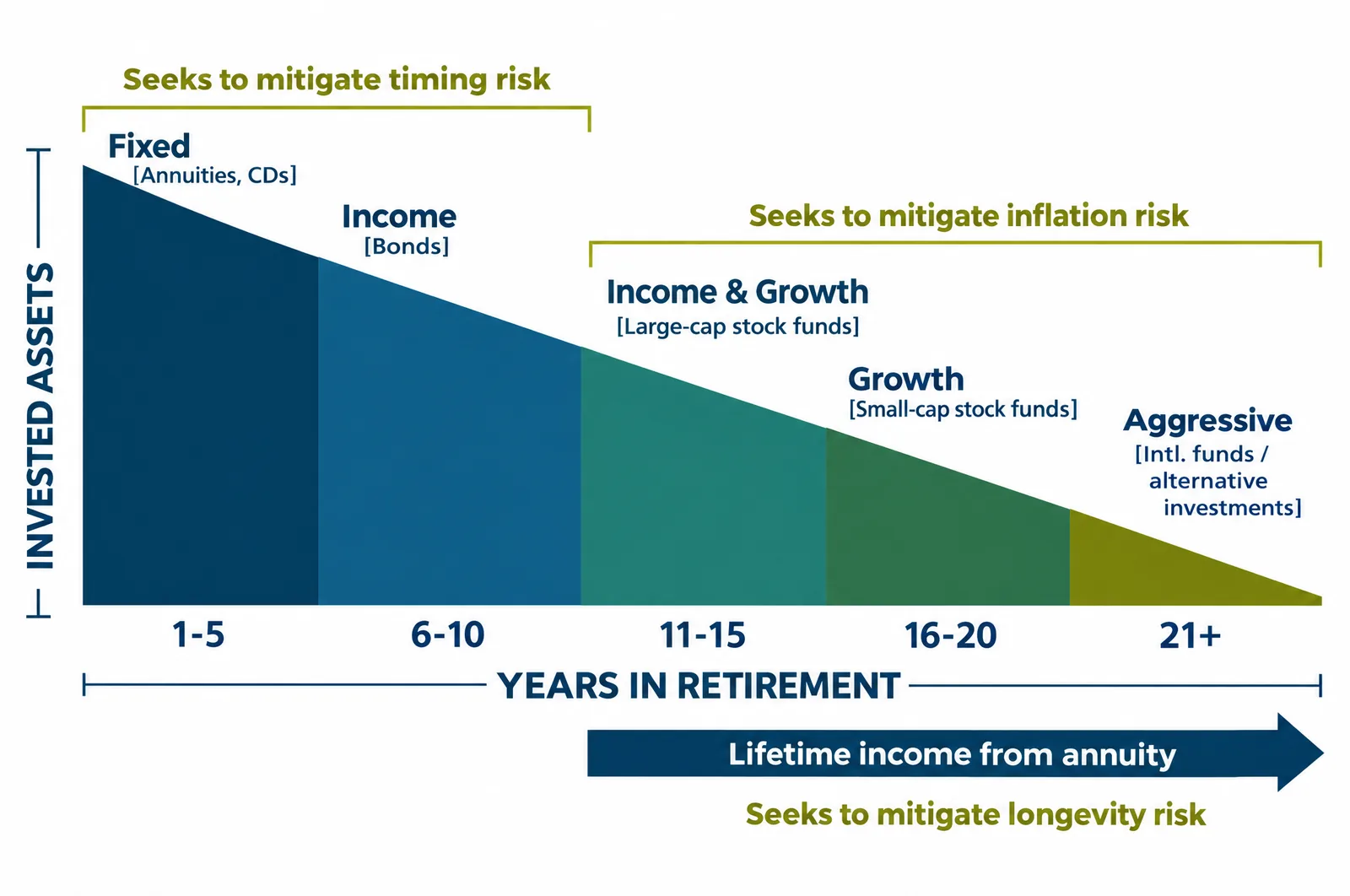
NextPhase organizes money around when it is expected to provide income. Near-term segments emphasize stability. Later segments have longer investment horizons and may take more market risk in pursuit of growth.

The framework includes five income periods covering years 1–25, plus a sixth segment for year 26 onward or legacy goals. A separate cash reserve and an optional longevity strategy can add flexibility.

Match risk to when you need the money

Income soon. More time for growth later.

Near-term spending
More conservative investments

Longer-term goals
More growth potential and market risk

Bucket 1
Years 1–5
Bucket 2
Years 6–10
Bucket 3
Years 11–15
Bucket 4
Years 16–20
Bucket 5
Years 21–25
Bucket 6
Year 26 onward

This describes different buckets held at the same time. It does not mean becoming more aggressive as you age. A longer horizon does not eliminate risk, and later buckets may shift toward stability as withdrawals approach. The triangle shows a concept, not return projections or recommended allocation percentages.

Illustrative NextPhase triangle: early conservative assets seek to address timing risk, later growth assets seek to address inflation risk, and optional lifetime annuity income seeks to address longevity risk.

The chart groups years 21 and beyond into one band. The six-segment framework separates years 21–25 from year 26 onward. Asset types are illustrative, not recommendations. Segmentation does not eliminate risk or guarantee income. Annuity guarantees depend on contract terms and the issuing insurer’s claims-paying ability.

Two small sailboats leaving the same dock on a Midwestern lake, one side of the sky golden and calm, the other a dark storm front

Why early withdrawals deserve attention.

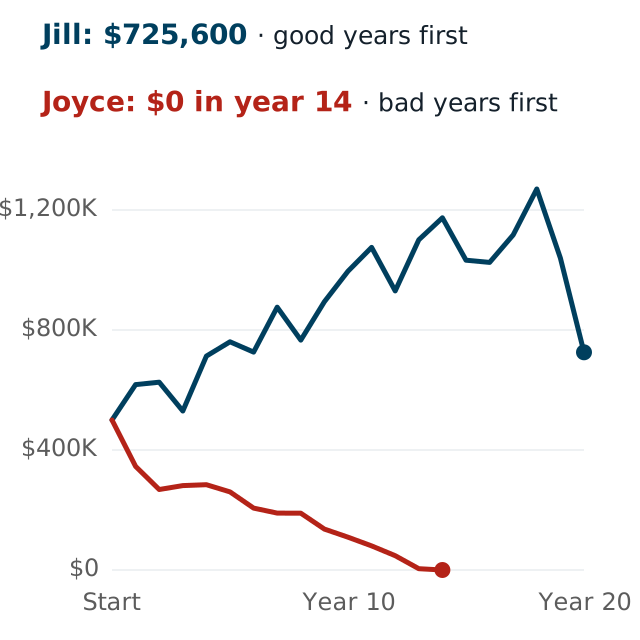
Timing risk is about the order of investment returns while you are taking withdrawals—not predicting the best day to invest. A decline early in retirement can be particularly damaging because spending continues while the portfolio is down. Selling more shares to meet the same income need leaves fewer shares participating in any later recovery. The comparison below shows why average returns alone do not tell the whole story. Both hypothetical portfolios experience the same annual returns in a different order, but withdrawals lead to very different outcomes.

How NextPhase can help We start with the income your savings need to provide after accounting for other sources. Near-term segments emphasize stability and accessibility, while later segments pursue longer-term goals. This seeks to reduce dependence on selling growth investments during a downturn. The plan still needs attention. We review available reserves, spending flexibility and the progress of later segments. If results fall short, adjustments may include reducing discretionary withdrawals, changing allocations or using a segment earlier. Buckets do not eliminate market risk or ensure that a recovery arrives in time.

Line chart: with $1,000,000 and $50,000 withdrawn each year, the retiree who meets losses first ends 15 years with about $628,000; the retiree with the same returns in reverse order ends with about $1,025,000

Hypothetical illustration from the supplied NextPhase guide. Both examples start with $500,000 and take $30,000 at the beginning of year one, with withdrawals increasing 3% annually. They use the same annual return series in reverse order. The calculation gives approximately $725,600 after 20 years for Jill; Joyce exhausts the portfolio in year 14. No taxes or fees are included. These are illustrations, not actual client results, investment recommendations or forecasts. Different returns, withdrawal timing, costs and taxes would change the results.

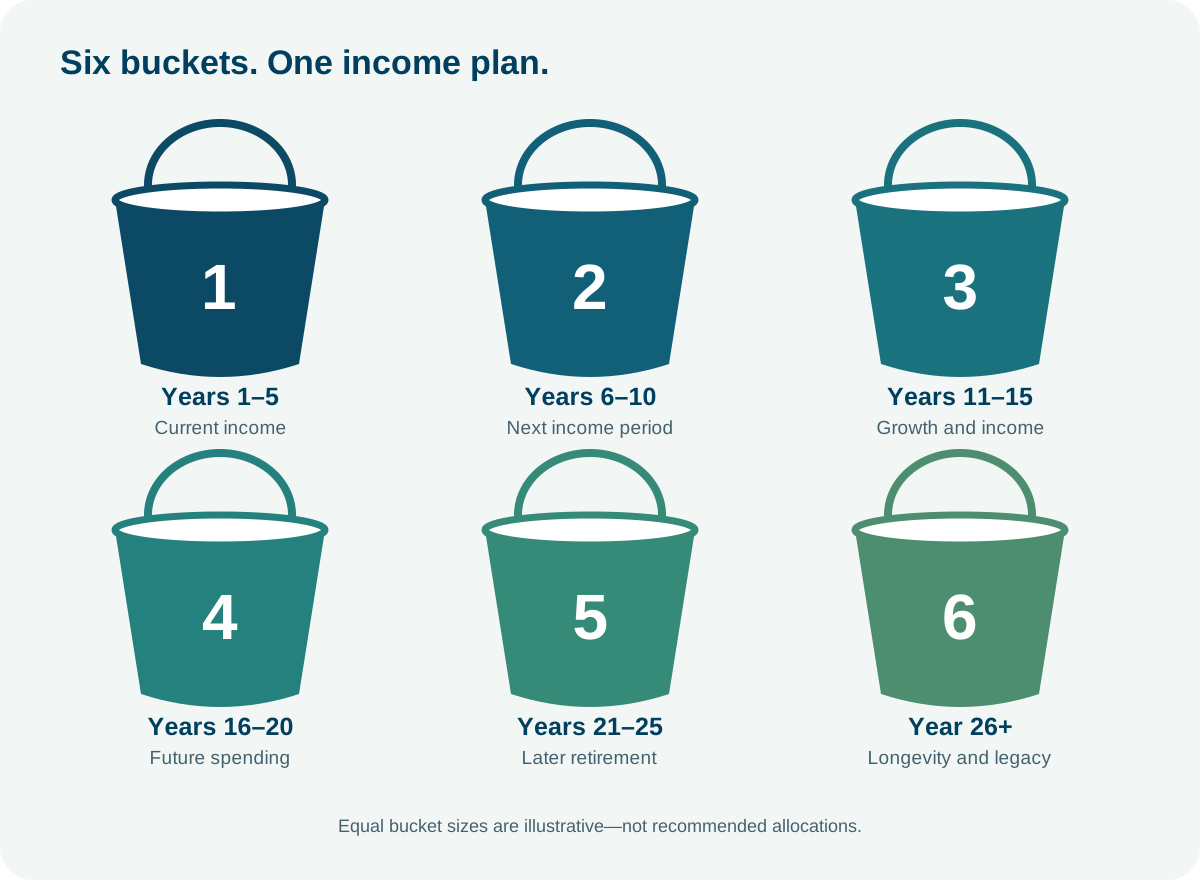
Six segments, each with one job.

Each segment has a planned role and time horizon. The first supports current withdrawals while later segments seek growth. Investment choices and the timing of changes depend on your needs, risk tolerance and the progress of the plan.

Bucket 1

Years 1–5

Current income

Available now

Bucket 2

Years 6–10

Next income period

5-year horizon

Bucket 3

Years 11–15

Growth and income

10-year horizon

Bucket 4

Years 16–20

Future income

15-year horizon

Bucket 5

Years 21–25

Later retirement

20-year horizon

Bucket 6

Year 26 onward

Longevity or legacy

25-year horizon

Spend from the current income bucket.
Its investments emphasize stability for planned withdrawals.

Give later buckets time to work.
Review their progress and consider more stable investments as income needs approach.

Conceptual illustration. Bucket sizes and fill levels do not represent allocations, balances or expected returns. Timing and investments depend on your plan; changes may be needed earlier.

SEGMENT 01 · Years 1–5

Income for the first years

Near-term assets are selected to support planned withdrawals, with an emphasis on stability.

SEGMENT 02 · Years 6–10

The next income period

A longer preparation period gives this segment time to work toward its income target before withdrawals begin.

SEGMENT 03 · Years 11–15

A longer horizon

Investments are selected for a longer horizon, balancing growth objectives with the risks you can accept.

SEGMENT 04 · Years 16–20

Future spending needs

This segment seeks growth to help support spending later in retirement. Its target is not a guaranteed result.

SEGMENT 05 · Years 21–25

Later retirement

The plan assigns resources to another five-year income period while accounting for uncertainty about future costs.

SEGMENT 06 · Year 26 onward

Longevity and legacy

The longest-horizon segment may support additional income or legacy goals, depending on your circumstances.

This framework is an illustration of how time segmentation works, not a recommended allocation for every investor. Investments can lose value. If a segment misses its target, income, timing or allocations may need to change, including using other segments earlier. Asset allocation does not guarantee a profit or protect against loss.

Plan for changing purchasing power.

Inflation can quietly change what a comfortable retirement costs. A monthly income that covers your lifestyle today may not buy the same things ten or twenty years from now. Healthcare, housing and other expenses can also rise at different rates, so one inflation assumption may not capture every part of your budget. How NextPhase can help We build future spending needs into the plan rather than assuming today’s budget will remain unchanged. Later segments can target higher income and seek growth over longer time horizons, while near-term segments support current spending. The balance depends on your resources, goals and ability to accept investment losses. We also review which income sources may increase and which remain fixed, then revisit the assumptions as your expenses and circumstances change. Holding more cash may reduce short-term market exposure, but it can leave purchasing power vulnerable. Growth investments bring their own risks and may not keep pace with inflation. Planned income increases are not guaranteed.

Broad flat limestone steps rising up a tallgrass prairie hillside toward a bright morning sky
A woman in her late seventies and her adult daughter walking down a long straight gravel road through farmland at dawn

Make room for a longer retirement.

The sixth segment is intended for income beyond year 25 or for legacy goals. Your planning horizon should reflect your circumstances, including whether the plan needs to support a surviving spouse.

A long retirement is something to plan for. Longevity risk means your income may need to continue for more years than you originally expected. Planning only to an average life expectancy can leave a gap if you live longer. For a couple, the income plan should also consider the surviving spouse’s needs, along with changing expenses and legacy goals. How NextPhase can help We look at how essential expenses could be supported by Social Security, pensions and other income, then assess what your savings still need to provide. The sixth segment addresses year 26 onward or legacy priorities, and ongoing reviews help revisit the balance between current spending and later needs. An optional annuity-based strategy may provide lifetime income when appropriate. Before considering one, the discussion includes fees, surrender charges, access to your money, inflation features and survivor benefits. Different contracts offer different protections and trade-offs. Insurance guarantees depend on the issuing insurer’s claims-paying ability and contract terms; the investment segments themselves do not guarantee lifetime income.

Build around your whole financial picture.

The segments are one part of the conversation. Existing income, accessible cash and personal priorities help determine how the plan is built.

Income already in place

Bring your Social Security estimate and details of pensions, other income and existing annuity income riders. Understanding their amounts and timing helps clarify what your savings still need to provide.

Cash for the unexpected

A separate reserve can be considered for expenses outside your regular budget. The amount should reflect your needs and the trade-off between ready access to cash and investing for longer-term goals.

Choices that fit your life

The discussion includes your need for income stability, comfort with market risk, cash needs and legacy priorities. Insurance costs, healthcare coverage and estate planning may call for coordination with other professionals.

From a conversation to a written plan.

NextPhase fits within our broader financial planning relationship. See our five-step planning process →

  1. Clarity Call

    Twenty minutes on what is changing and whether a written income analysis makes sense. No cost, no pressure.

  2. Discovery

    We organize your spending, income sources, accounts and insurance. Four questions guide the discussion: how much income stability you need, how much market risk you can accept, what cash should remain accessible and what you want to leave for others.

  3. Income and risk analysis

    We compare your income needs with your available resources and consider the timing and risks of the proposed segments. We identify questions about Social Security, healthcare, taxes and estate planning that may need further analysis or coordination with your other professionals.

  4. Your written NextPhase plan

    Your personalized analysis outlines the proposed segments, targeted income and the assumptions behind the plan. We review the choices and trade-offs with you before implementation.

  5. Review and maintain

    Review the plan as your circumstances and investment results change. Adjustments may involve income, allocations or the timing of a segment’s use. The five-year periods provide a planning framework; they do not prevent an earlier change when needed.

Questions people ask about the process.

Is this only for people with large portfolios?

NextPhase is intended for people who want to understand how savings could support retirement income. Whether it fits depends on your income needs, resources, time horizon and willingness to accept risk. The first conversation helps assess that fit.

Does segmentation remove market risk?

No. Investments involve risk, including possible loss of principal. Organizing assets by time and purpose can help guide withdrawals, but it does not guarantee that a segment will reach its goal or that income will last for life.

What if my situation changes?

A separate cash reserve can help cover expenses outside your monthly budget, if included in your plan. Larger changes may require revisiting spending, investments or the timing of withdrawals. Contact your advisor when your needs change.

Do you give tax or legal advice?

No. We coordinate the analysis with your tax and legal professionals, who advise on your specific circumstances.

What should I gather for the planning conversation?

Your expected retirement date, a retirement spending estimate, recent account statements, Social Security benefit estimates, pension details, and existing annuity and insurance information are useful starting points. Include expected large expenses and the goals you want the plan to support. Your advisor can explain which documents are needed after the initial call.

Ask for your written income plan.

The first conversation is designed to clarify what is changing and whether a written retirement income analysis would help. Or call 800-971-2989.

NextPhase is a time-segmented retirement income planning framework. Securities and investment advisory services offered through Osaic Wealth, Inc., member FINRA/SIPC. Osaic Wealth is separately owned and other entities and/or marketing names, products or services referenced here are independent of Osaic Wealth. This page is educational and is not individualized advice. Consult your tax and legal professionals regarding your circumstances.

Start Here

Take the First Step Toward Financial Confidence

At Lifetime Retirement Partners, we’re here to help you navigate your financial journey. Let’s create a personalized plan that aligns with your goals and adapts as your life evolves, providing you with confidence and peace of mind along the way.