The American Tobacco Company. The National Sugar Refining Company. International Harvester. Believe it or not, they are all potential answers to a question that Financial Advisors often field: “How can the stock market just keep going up over time?”
There are several appropriate responses, and we focus on just one today: the stock market can “just keep winning” because the market is always changing.
Before diving into the details as they relate to investments, it is worth introducing the idea popularized by twentieth century economist Joseph Schumpeter. He coined the phrase “creative destruction” to describe what transpires in a market-driven capitalist society. Per Schumpeter:
“Capitalism is by nature a form or method of economic change and… [can] never can be stationary.” – Joseph Schumpeter, Capitalism, Socialism, and Democracy
In simple terms, innovation and competition continually replace older industries and companies with new ones, driving long-term economic expansion.
This evolution, like a perennial clearing of dead forest, makes way for new growth. It is what keeps an index like the S&P 500 in a default state of moving “up”.
First formed in 1957, when the U.S. economy was ready to graduate beyond smaller benchmarks (such as thirty stock Dow Jones Industrial Average), the new index represented 500 large U.S. companies across many industries. The original formulation included businesses which remain household names such as 3M, Coca-Cola, IBM, and Procter & Gamble. However—and this is key—it also included names such as the Studebaker Corporation, an automobile manufacturer which ceased production in 1966. Or, as referenced earlier, it included companies like the American Tobacco Company or the National Sugar Refining Company; businesses that haven’t operated in decades.
Since 1957, companies have come and gone. If they hadn’t, the index would likely have shown a much lower return over time. Of the original 500 companies, only about fifty are still in business today. Instead, Standard & Poor’s has replaced businesses at a rate of approximately twenty per year, which implies 20% turnover every five years. Weak, underperforming companies are constantly replaced with newer, stronger ones. Just this month, Standard & Poor’s announced a series of additions and removals:
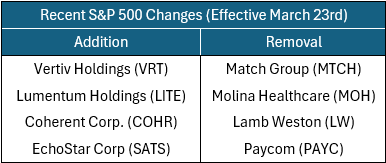
For an example of creative destruction, consider dating site purveyor Match Group which went public in 2015 and was added to the S&P 500 in 2021. As its brand Tinder became the dominant dating app on the globe, corporate earnings and growth surged (as did the stock price). More recently, company growth has slowed and the stock price has dropped dramatically. Instead of remaining as an anchor, dragging on the remaining S&P 499, it is being replaced by a company with stronger prospects. Will one of the new S&P companies be the “next big thing”? Perhaps. If not, they may be replaced.
It is this type of ongoing innovation that makes the market seem astonishingly resilient over long stretches of time. Yet, for those who follow only the headline adjustments in the S&P 500, the evolution goes almost unseen. It is analogous to the growth of a child. If you sit and try to watch for a day you won’t see much. Come back a year later and an amazing process has taken place.
Returning to Schumpeter, written before the S&P 500 had been brought into existence:
“The opening up of new markets, foreign or domestic, and the organizational development… illustrate the… industrial mutation that incessantly revolutionizes the economic structure from within.” – Joseph Schumpeter, Capitalism, Socialism, and Democracy
To be sure, the market has winners and losers. But it is this kind of creative destruction that allows the economy to expand—and the market to go up—over time.